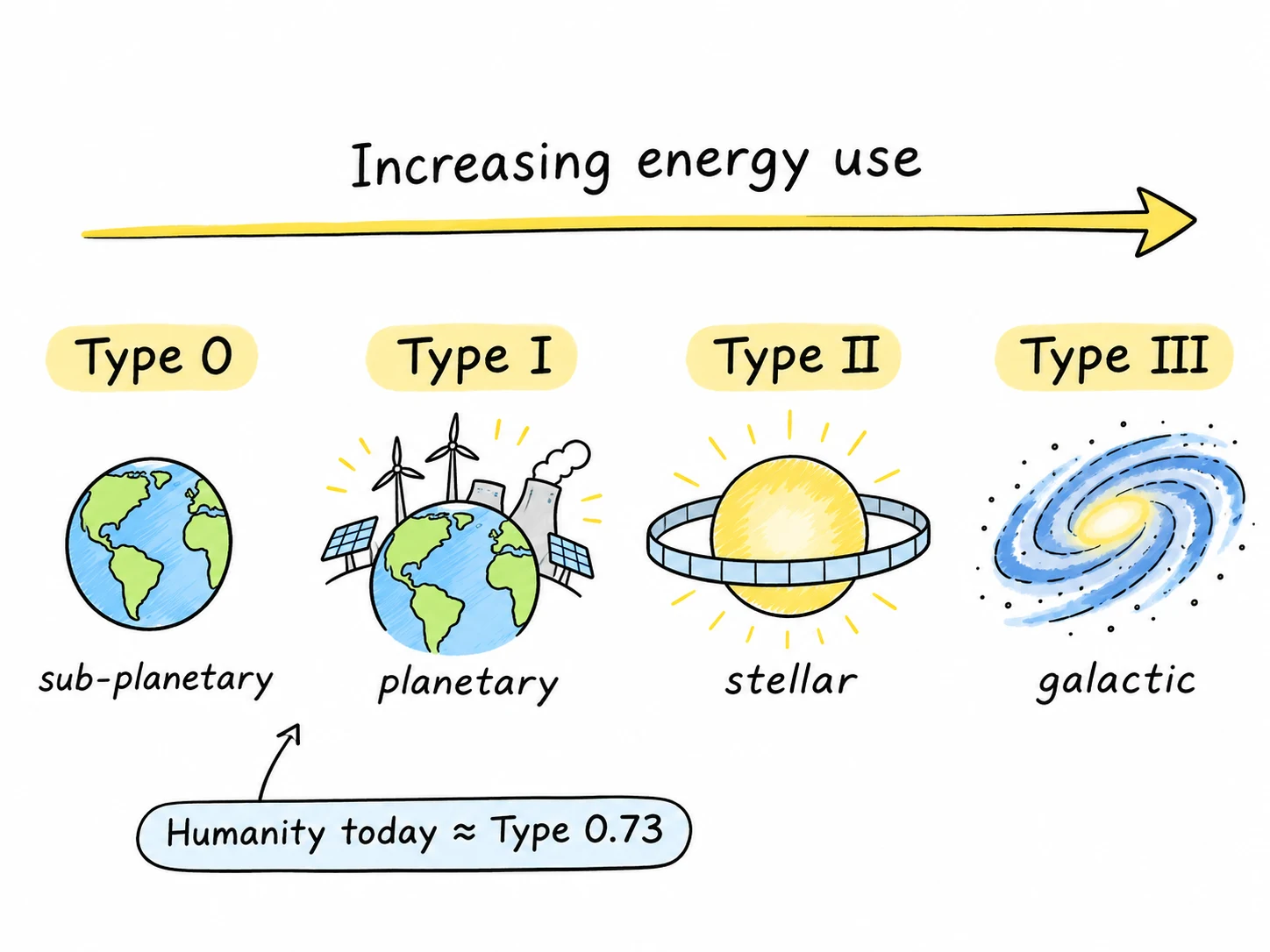
Type 0.73
Humanity runs on a fifth of one per cent of the power a planetary civilization would command, and its newest machines are already short of wire.
In December 1963 Nikolai Kardashev, an astrophysicist at the Sternberg Astronomical Institute in Moscow, sent a short paper to a Soviet astronomy journal. He wanted to know how other civilizations might be found by their radio signals, and to estimate how strong such a signal could be he needed a way to rank whoever was sending it. A radio telescope cannot register what a distant society knows or wants. It registers power. So Kardashev sorted civilizations into three types by the energy they spend each second. The first spends about what humanity did in 1963, the second the entire output of its star, and the third the output of its galaxy. The scale was made for looking outward, and for most of the sixty years since it has belonged to astronomers and to science fiction. It is now being pointed at Earth. In September 2025 OpenAI and Nvidia announced a plan to build computers that they measured in gigawatts, at least ten of them, and a ladder that ranks a civilization by power alone has become a way of talking about our own.
The number at the top of this essay is not Kardashev's. His first type was simply the Earth as he found it, a planet spending about four trillion watts, and by that definition humanity qualified on the day he wrote the paper. The demotion came a decade later. In 1973 Carl Sagan proposed writing the types in ordinary numerals so that they could carry decimals, and he moved the first rung up to ten thousand trillion watts, about a seventeenth of the sunlight that reaches the Earth. Each tenth of a type became a tenfold increase in power. On Sagan's scale the Earth of 1973 rated about 0.7. Robert Gray, an American researcher who recalculated the scale in 2020, put humanity at 0.58 in 1800 and 0.61 in 1900. World energy use reached 592 exajoules in 2024, by the Energy Institute's count, which is a little under nineteen trillion watts, and that makes us Type 0.73. Two centuries of industry have been worth fifteen hundredths of a type. The twenty-seven that remain are a factor of more than five hundred.
Kardashev did not expect the climb to slow. The forecasts he had to hand put the growth of humanity's energy use at three to four per cent a year for the next sixty years, and he wrote that he saw "no reasons why the tempo of increase in energy consumption should fall". Even at one per cent a year, he calculated, humanity would match the output of the Sun in 3,200 years. The sixty years are now up. Growth has averaged about 2.6 per cent, and in the rich world it seemed for a time to have stopped altogether. American electricity consumption, by the reckoning of the country's Energy Information Administration, was "essentially flat for nearly two decades". Then the data centres arrived. The International Energy Agency expects them to account for almost half of the growth in American electricity demand between now and 2030, by which year the United States would use more electricity to process data than to manufacture all of its energy-intensive goods, among them steel, cement, aluminium and chemicals. An old assumption has come back with them, which is that a civilization that uses more energy is a civilization that can do more. Kardashev took it for granted, because power was all his telescope could see. The argument of this essay is that the two can come apart, and that the machines now being plugged in are the first real test of how far.
The thing doing the climbing is a graphics chip. Nvidia's H100, a workhorse of the present boom, is rated by its maker to draw up to 700 watts. Plenty of household appliances draw more. The difference is that the chip is never switched off. One that ran at its rating for a year would use 6,132 kilowatt-hours. Put the same electricity into a Tesla Model Y, which the Environmental Protection Agency rates at 29 kilowatt-hours for every hundred miles, and the car would travel about 21,000 miles, most of the way around the Earth at the equator. The average American driver covered 13,735 miles in 2024, according to the Federal Highway Administration, so one chip that never moves uses the electricity of about one and a half cars that do. The chip does not work alone. Nvidia sells the H100 in machines of eight, with the processors, memory and fans they need, and rates each machine at 10.2 kilowatts. That is the annual electricity of twenty-two such cars, before any of the building's cooling is counted. These are ratings, and a real chip spends part of its life below them. But a data centre is built, wired and cooled for the rating, and the rating is what the grid has to be ready to supply.
Nobody outside Nvidia knows how many of these chips are running. The company reports its revenue, not its unit sales. The best public estimate comes from Epoch AI, a research group that works backwards from that revenue, and it put the installed stock at the equivalent of about four million H100s at the start of 2025. The International Energy Agency counted almost 58 million electric cars on the road at about the same date. The cars are the larger fleet and the smaller load. Together they used about 180 terawatt-hours of electricity in 2024, by the agency's reckoning, while the world's data centres used about 415. Only part of that is the new chips, since data centres also store the photographs and serve the films, but it is the part that is growing. The agency expects the electricity used by the specialized servers that hold them to rise by 30 per cent a year until 2030, against 9 per cent for the ordinary kind, and it expects data centres as a whole to reach about 945 terawatt-hours by then. Electric cars will have multiplied their appetite more than fourfold, to 780, and will still not have caught up. Epoch's estimate carries a second number. The computing power of the installed chips has grown 2.3 times a year since 2019, which is a doubling every ten months. Electricity that grows at 30 per cent a year doubles about every two and a half years. The two figures do not cover quite the same machines or the same years, but the gap between them is too wide to be an accident of bookkeeping. The ladder records the second rate and has no rung for the first.
Very little of this power is where it is wanted. A typical data centre built for artificial intelligence uses as much electricity as 100,000 households, the International Energy Agency says, and the largest now under construction will use twenty times that, which is two million homes arriving on a single site. Half of those being developed in America are going into places that already hold large clusters of them. The electricity itself can be found. The agency expects renewable sources to supply half of the growth in data centres' demand and natural gas, mostly in America, much of the rest, with nuclear power arriving later. What cannot be found quickly is the connection. A data centre can be running two to three years after work begins. A new transmission line takes four to eight years to build in a rich country, by the agency's count, and the wait for transformers and cables has doubled in three years. In the United States, Lawrence Berkeley National Laboratory counted about 8,200 power plants and batteries waiting for permission to connect at the end of 2025, some 2,000 gigawatts of them, and the typical project that did reach the grid that year had spent more than five years in the queue. The agency reckons that one planned data centre in five could be delayed unless the grid catches up. For the present the shortage is one of wire.
So the builders have stopped waiting for it and gone to find power of their own. The quickest kind to add needs no fuel. Of the 86 gigawatts of generating capacity that developers plan to switch on in America in 2026, which would be a record, the Energy Information Administration counts almost four-fifths as solar panels and batteries. Natural gas accounts for about 6 gigawatts. But a data centre wants its power at every hour of the night, and so the industry has gone looking for the older kinds, which are harder to get. The International Energy Agency reports that new gas turbines now take several years to arrive, long enough that a plant ordered today could miss 2030. Nuclear power is slower still, with one exception, which is a reactor that already exists. Unit 1 at Three Mile Island in Pennsylvania, shut in 2019, is being refitted to reopen as early as 2027, and Microsoft has contracted to buy its output for twenty years. Its neighbour, Unit 2, is the one that partly melted down in 1979. Duane Arnold in Iowa, shut in 2020, is due back in early 2029 to supply Google. The small new reactors that the technology companies have ordered are expected from about 2030. Most of those designs burn a richer grade of uranium than today's reactors do, and the only American plant that enriches it is a government demonstration in Ohio that has so far produced about 900 kilograms. A civilization climbing Kardashev's ladder would be expected to find new sources of power. For the moment this one is reopening its old ones.
The chips come from fewer places than the power does. Nvidia designs the H100 in California and does not make it. The making is done in Taiwan by TSMC, using a process the two companies call 4N. In 2021 the Semiconductor Industry Association and the Boston Consulting Group found that 92 per cent of the world's capacity to make the most advanced chips was on that one island, and the rest in South Korea. Factories now opening in Arizona have begun to dilute the share. The factories in turn depend on a single supplier. The machines that print the finest features are built only by ASML, a Dutch company, and one of them travels to its buyer in about 40 freight containers, on three cargo aircraft and twenty lorries. Chipmaking is also a climb of its own on Kardashev's ladder. TSMC used about 25.5 terawatt-hours of electricity in Taiwan in 2024, roughly nine per cent of all the power consumed on the island. That is about what four million H100s would draw if they ran at their rating all year, which is roughly the stock that Epoch believes is installed. The rating agency S&P Global has sketched a case in which the company's share of the island's electricity approaches a quarter by 2030. A civilization's place on the ladder is a single number. The means of raising it pass, for now, through one island and one town in the Netherlands.
Nor do the machines stay built. In 2024 Meta published an account of training one of its large models on as many as 16,000 H100s. Over a stretch of 54 days the work was interrupted 466 times. Forty-seven of the stops were planned and 419 were not, which is one about every three hours. The company attributed some 78 per cent of the unplanned ones to hardware, and 59 per cent to faults in the graphics chips themselves. Its engineers were not alarmed. Software restarted the job each time, people had to step in on only three occasions, and the cluster spent more than nine-tenths of the period doing useful work. But the paper describes what a machine of this size is, which is one where something is always broken. It adds that when tens of thousands of chips begin or end a step together, the data centre's demand can swing by tens of megawatts in an instant, enough to stretch what the authors call "the limits of the power grid". A chip that never fails is still on borrowed time. Amazon lengthened the working life it assumes for its servers from five years to six at the start of 2024, and a year later cut it back to five for some of them, its finance chief citing the pace of development in artificial intelligence. A rung on Kardashev's ladder was meant to stay climbed. This one has to be bought again about twice a decade.
Training is the rare event. A model is trained over weeks or months and then spends its working life answering, which the trade calls inference. Failure looks different there. No operator publishes how often the chips that serve answers break. What it costs them can be read instead in what they hold in reserve, because a request that meets a dead chip is simply sent to another, and so a service has to keep machines switched on with nothing to do. Researchers at the University of Illinois followed 1,056 Nvidia chips in a supercomputer for two and a half years and concluded that a large system needs about five per cent more of them than its work requires, to stand in for the ones that are down. In August 2025 Google's engineers went further and published the energy bill for a single answer. A median text prompt to its Gemini assistant, they found, uses 0.24 watt-hours, less than a television does in nine seconds. The chips doing the answering account for 58 per cent of that. A quarter goes to the ordinary processors and memory beside them, eight per cent to cooling and other overheads, and ten per cent to what the paper calls idle machines, kept "ready to handle traffic spikes or failover". The more striking number was the trend. Over twelve months, Google reported, the energy used by a median prompt had fallen 33-fold. That is a measurement of the thing Kardashev's ladder leaves out: an answer of the same kind, for a thirty-third of the power.
There is an old objection to all this, and it is a serious one. In 1865 William Stanley Jevons, an English economist of twenty-nine, published The Coal Question, a book that asked how long Britain's coal would last. Engineers took comfort from the fact that engines were growing thriftier. In less than a hundred years, Jevons reckoned, the steam engine had become at least ten times as efficient. He drew the opposite conclusion from the one they wanted. "It is wholly a confusion of ideas to suppose that the economical use of fuel is equivalent to a diminished consumption," he wrote. "The very contrary is the truth." His plainest example was iron. The ironworks of Scotland had cut the coal they burned for each ton of iron to less than a third of what it had been, and their consumption of coal had risen tenfold. Thrift made iron cheap, cheap iron found new uses, and the new uses burned more coal than the thrift had saved.
The argument transfers to answers without adjustment. In January 2025 a Chinese company, DeepSeek, released a model that it said matched its American rivals at a fraction of their cost, and shares in the companies that make and sell computing power fell sharply. Satya Nadella, the chief executive of Microsoft, replied by naming Jevons. As artificial intelligence becomes more efficient, he wrote, "we will see its use skyrocket, turning it into a commodity we just can't get enough of". The record so far is on his side. In roughly the twelve months in which Google cut the energy of a median prompt 33-fold, the volume of text its models processed each month rose about fifty-fold, from 9.7 trillion of the fragments the trade calls tokens to more than 480 trillion. The two figures do not measure quite the same thing, but there is no doubt which of them won. The electricity used by Google's data centres rose by 27 per cent in 2024. On this view the thrift of the machines is the engine of their growth, and the doubling that the International Energy Agency projects for 2030 is what Jevons would have predicted. If that is right, Kardashev was right too, and power is the only number worth keeping. A civilization that learns to get more from each watt does not use fewer watts. It finds more to do, and climbs.
Jevons deserves a better answer than he usually gets, and the first part of it is that his rule is not a law. The American record that opened this argument holds a counter-example. For nearly two decades the population grew, the economy grew, and the use of electricity did not, because that growth, in the words of the Energy Information Administration, was offset by "efficiency improvements and other structural changes in the economy". Appetites can be met. Nobody yet knows whether the appetite for answers will reach its fill, as America's appetite for electricity did for a time, or prove as bottomless as Scotland's for iron, and anyone who claims to know is selling something. Oliver, which publishes this essay, builds a database, and so has a stake in the argument that software should do more with less.
The second part of the answer is to grant Jevons everything and read what he wrote. He did not say that thrift was futile. He said it was the cause: Britain's better engines were the reason it burned ten times the coal. On his account what carries a civilization up the ladder is what it learns to get from each unit of fuel, and the fuel it goes on to burn is the consequence. The ladder records the consequence. The figures in this essay say the same of computing. Since 2019 the computing power of Nvidia's installed chips has grown 2.3 times a year, by Epoch's estimate. Over about the same years the electricity used by all the world's data centres grew by 12 per cent a year, according to the International Energy Agency, and the agency expects the specialized servers to need 30 per cent more each year from here. On either figure, the larger part of the growth in computing has come from doing more with each watt, and the smaller part from using more watts. For the rest of this decade the watts are rationed besides, by the wire, the turbines and the factories. Kardashev's scale has one number because a telescope can see only one. From close up there are two, which are how much power a civilization commands and what it gets for it. Jevons shows that the second drives the first. He does not show that the first is all there is to know.
Kardashev died in Moscow in August 2019, at eighty-seven, still running the institute he had founded. He had spent his life listening for civilizations that give themselves away by the power they spend, and the arithmetic of his scale is severe. If every data centre that the International Energy Agency expects by 2030 is built and switched on, the extra electricity will raise humanity's rating, on Sagan's version of the scale, from 0.7273 to about 0.7275. An astronomer on another world, pointing a telescope at this one, would see nothing worth writing down. Whatever has changed by then will have changed in the number that cannot be seen from there. The number at the top of this essay will not have moved.
Sources and methods
- The scale, the forecast and the quotation: N. S. Kardashev, "Transmission of Information by Extraterrestrial Civilizations", Soviet Astronomy, volume 8 (1964), submitted on 12 December 1963. His figure for humanity is 4 × 10¹⁹ ergs a second, which is 4 trillion watts.
- Sagan's grades, and the ratings for 1800 and 1900: Carl Sagan, The Cosmic Connection (1973), as set out by Robert Gray in "The Extended Kardashev Scale", Astronomical Journal (2020), and in an essay of 2021. A type is the logarithm of the power in megawatts, divided by ten.
- World energy use: the Energy Institute's Statistical Review of World Energy 2025 gives 592 exajoules for 2024. Divided by the seconds in a year, that is 18.8 trillion watts, or Type 0.727. Type 1.0 is 1016 watts, which is 533 times as much. Sunlight reaches the Earth at 1,361 watts per square metre across a disc 6,371 kilometres in radius, which is 1.74 × 10¹⁷ watts. Growth from 4 trillion watts in 1963 to 18.8 trillion in 2024 is 2.6 per cent a year.
- American electricity: the Energy Information Administration, Today in Energy, 13 May 2025. Both quotations are from that article.
- Data centres: the International Energy Agency, Energy and AI (April 2025) and its release of 10 April 2025. These supply the 415 and 945 terawatt-hours, the 12 per cent and 30 per cent growth rates, the comparison with households and with heavy industry, the clusters, the sources of supply, the building times and the one in five.
- The chip: Nvidia's H100 page gives up to 700 watts. Over 8,760 hours that is 6,132 kilowatt-hours. The machine of eight is the DGX H100, rated at 10.2 kilowatts as reported at its launch, or 89,352 kilowatt-hours a year.
- The car: the Environmental Protection Agency's rating for the 2024 Tesla Model Y Long Range is 29 kilowatt-hours per hundred miles, so 6,132 kilowatt-hours is 21,145 miles. The Earth is 24,901 miles around at the equator. The Federal Highway Administration's Our Nation's Highways 2026 gives 13,735 miles per licensed driver in 2024, which is 3,983 kilowatt-hours in that car. One chip is 1.54 such cars and the machine of eight is 22.4.
- Chips installed: Epoch AI, 13 February 2025. Growth of 2.3 times a year is a doubling every ten months. Growth of 30 per cent a year is a doubling every 2.6 years.
- Electric cars: the International Energy Agency, Global EV Outlook 2025. The 780 terawatt-hours for 2030 is its stated-policies scenario.
- The queue: Lawrence Berkeley National Laboratory, Queued Up, 2026 edition. It counts 1,312 gigawatts of generation and about 749 of storage.
- Capacity planned for 2026: the Energy Information Administration, Today in Energy, 20 February 2026.
- Reactors and fuel: the operators' announcements for Three Mile Island Unit 1 and Duane Arnold, the Department of Energy on the fuel, and Power magazine on the 900 kilograms.
- Chipmaking: the Semiconductor Industry Association and Boston Consulting Group (2021) for the 92 per cent. ASML's shipping figures, TSMC's electricity for 2024 and S&P Global's scenario are taken from press reports of each. TSMC's 25.55 terawatt-hours divided by 6,132 kilowatt-hours is 4.17 million.
- The training run: Meta, "The Llama 3 Herd of Models" (2024), section 3.3.4. Fifty-four days divided among 419 interruptions is 3.1 hours.
- Servers' working life: Amazon's annual report for 2024.
- One answer: Google, "Measuring the environmental impact of delivering AI at Google Scale" (August 2025). The spare capacity is from the University of Illinois, "Characterizing GPU Resilience and Impact on AI/HPC Systems" (2025).
- Jevons: The Coal Question (1865), chapter VII.
- Satya Nadella's post of January 2025, as quoted by Fortune. Google's tokens are from its keynote of 20 May 2025 and its electricity from its 2025 Environmental Report.
- The last paragraph: 945 less 415 is 530 terawatt-hours a year, an average of 60 billion watts. Added to 18.8 trillion watts, it moves the rating from 0.7273 to 0.7275. Kardashev's dates are from his obituary in Physics Today.